
A few weeks ago, I came across a short clip of a woman explaining that she was ‘quiet quitting’ a friendship. Quiet quitting is a term that originally applied to jobs, about when employees check out mentally from their jobs and do the minimum amount of work. ‘Quiet quitting’ a friendship means that they are emotionally disengaging from their friend in hopes that the friendship will run its course without direct confrontation. In essence, quiet quitting is synonymous with ‘ghosting’, just packaged differently.
It is completely natural to slowly stop being friends with someone. A friendship does not have to implode horribly or have a heated confrontation for it to end. It can simply end because you don’t have many things in common anymore between the two of you. Once you are not in the same place anymore, both physically and also in life, it is sometimes difficult to maintain a friendship with someone. And that is fine, because such is the course of growing up.
Quiet quitting, on the other hand, feels like a calculated term. There are a million reasons why someone is justified in leaving a friendship or attempting to distance themselves from someone. Maybe they have already had this conversation time and again and don’t see that friend changing. Maybe they feel exhausted and mentally drained by their friend’s behavior.
However, these buzzwords often metastasize into something that it is not. It seems like many people are using the phrase as a copout to leave a friendship for an unexplained reason with no closure for the other person. Of course, if a friend is extremely toxic and is truly causing you distress, I think that you should not be obligated to confront them (unless you want to). But when the rift in friendship boils down to miscommunication or simply one or two elements of being upset, it is sometimes wholly worth having a mature discussion about it as well.
One of my favorite articles, Is Therapy Making Us Selfish? explores the rise of therapy speak in daily life and relationships. While therapy and mental health counseling becoming more destigmatized and common has helped more people than we can imagine, people often misuse therapy language and in wrong situations as well. This dilutes what it should actually mean and do and becomes an excuse and justification for people to, well, be terrible.
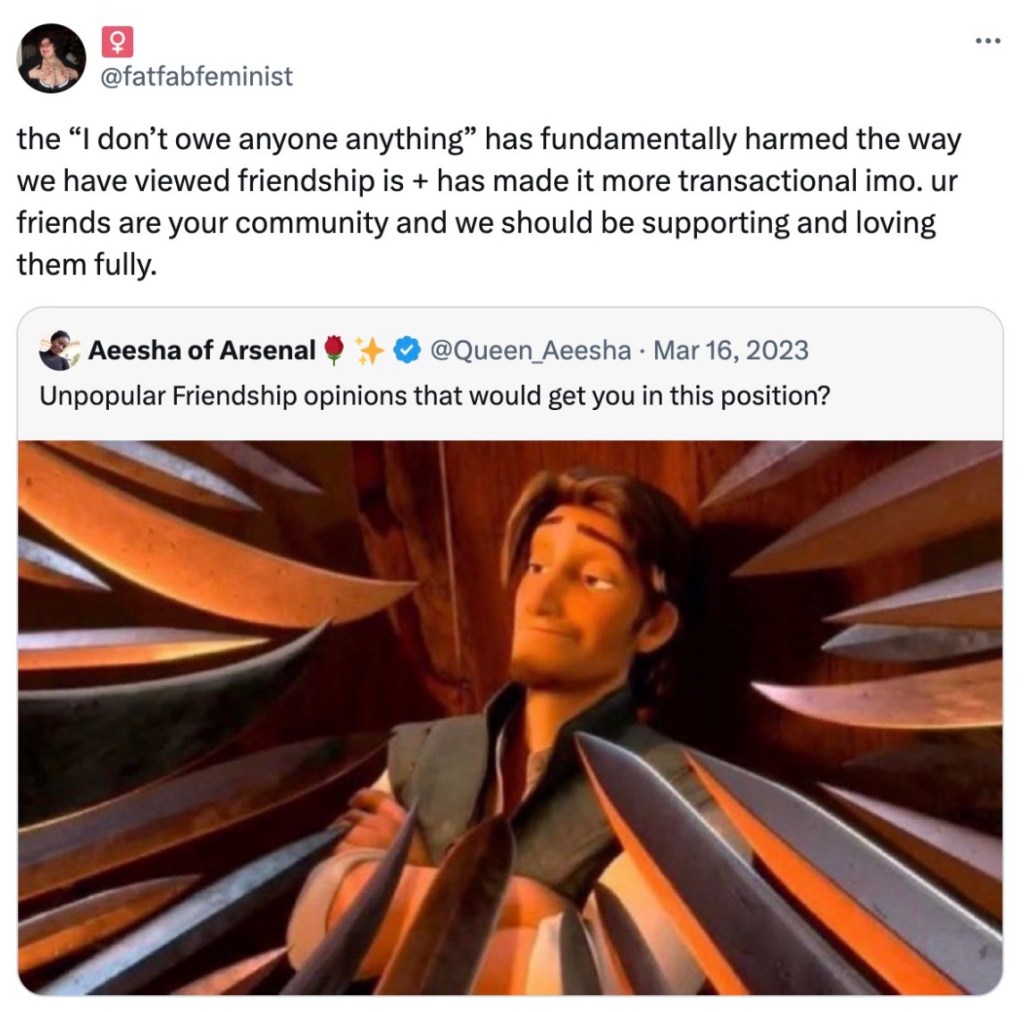
The line “you don’t owe anyone anything” has become prevalent when setting boundaries for yourself and interactions. Setting boundaries and thinking about your own well-being and mental health are incredibly important life skills. However, like most therapy languages, they are taken out of context and are misapplied.
Once friendship becomes something about “owing someone”, it becomes inherently transactional in nature. Oftentimes, these transactions are measured in currencies we cannot exact a number on. How do you measure emotions? How do you measure trust? How do you measure time and effort? (And if one does view friendship as a transaction, they should think about whether or not they actually like that friend).
There are reasons a person might be tempted to overindulge in some of this self-care behavior. Conflict can be difficult, and people might think they can avoid it by asserting their needs in a way that prevents the other person from responding — by using HR language to end a friendship, for instance, or via straight-up ghosting. And by couching the behavior in therapy language, the hard “boundary” can feel more legitimate, or even virtuous.
But Marisa G. Franco, a psychologist, professor, and the author of Platonic: How the Science of Attachment Can Help You Make — and Keep — Friends, says that encouraging people to set boundaries in a way where you’re only considering your needs and not someone else’s can hinder creating healthy relationships.
—Is Therapy Making Us Selfish?

Phrases such as ‘emotional labor’ and ‘trauma dumping’ have become colloquialized and thus trivialized. Isn’t friendship simply about loving and trusting and being interested in their lives? Isn’t it about sharing? When one begins defining talking and listening to a friend as ‘emotional labor’, it becomes less of a friendship and more of an HR meeting. Being kind and caring towards someone is simply being a good person and a good friend. It is not some bill that you can pull out to put the other person in debt.
Again, it is important that moderation and nuance are emphasized because I am not saying that one needs to always drop everything for a friend. If I am especially busy or overwhelmed or unable to mentally fully be there for them because of a depressive episode, I’ll let them know. Being a good friend goes both ways—the willingness to listen but also the willingness to be patient and understanding if your friend cannot speak to you at the moment.
Of course, if I am busy or unable to fully be there mentally for them, I’ll tell them. But it is less of “I am setting boundaries because I cannot perform emotional labor for you”, but more of a simple “I’m going to be MIA for a little bit because work is super hectic right now / I’m not feeling great”.

Friendship and my friends are one of the most near and dear parts of my life. I love hearing about their days. I love and feel privileged when they trust me enough to share worries and ask for my advice. And I equally feel grateful when they listen to me and treat me with importance. Friendships should be imbued with appreciation and consideration instead of calculative transactions.
Two years ago, I wrote about what friendship means to me in my 20s. And I think my sentiments back then is very apt for this post:
Sometimes my friends are mirrors of myself, other times we are complete opposites. Regardless, they are there for me constantly, consistently, unfailingly, whether I ask for it or not, and I’d like to think they know that I would absolutely do the same for them as well.
There is a line from Ghosts by Dolly Alderton that talks about friendship as “being the guardian of another person’s hope.” I’ve always used that as a guidepost for how I navigate my friendships, because I love the idea that no matter how crazy the world can get, how low the lows can be, and how unpredictable life can roll, you will still remain standing by the simple fact that your friends love you, that they will lift you up. Kind of like their love, their persistence in your life tethers you to the earth.
Friendship is love from two miles or two thousand miles away. It’s being the first to hear their drunken stories, understand their nearly undecipherable typos, be there through their horrible romantic choices and love them anyway. Friendship is constancy, it is shared strength, it is the security that when you feel adrift, your friend will always bring you back.
 postcards by ky
Leave a comment